
The Third Step Prayer: Finding Freedom Through Surrender
The third step prayer is often described as the vital turning point in a person’s recovery journey. After acknowledging powerlessness in Step 1 and finding hope in Step 2, Step 3 finally asks for tangible action. Consequently, it is the moment you decide to move from simply “knowing” to actively “doing.”
For many in Alcoholics Anonymous, the third step prayer words represent a profound shift in perspective. Furthermore, it is more than just a recitation; it is a commitment to let go of the “self-will” that often fuels addiction. Whether you are a newcomer or a long-timer, understanding this prayer is essential for navigating the 12-step process successfully.
What is the Third Step Prayer?
In the context of Step 3 prayer in Alcoholics Anonymous, the prayer acts as a formal way to affirm the decision to turn one’s life over to the care of a Higher Power. Although AA is not a religious organization, it is deeply spiritual. Because of this, the prayer serves as the verbal seal on a new spiritual contract.
The prayer is located on page 63 of the “Big Book” (Alcoholics Anonymous). Significantly, it marks the transition from the “thinking” phase of recovery into the “action” phase. By saying these words, you are essentially resigning as the director of your own life so that a higher wisdom can lead.
The Third Step Prayer Words
The traditional version from the Big Book is as follows:
“God, I offer myself to Thee—to build with me and to do with me as Thou wilt. Relieve me of the bondage of self, that I may better do Thy will. Take away my difficulties, that victory over them may bear witness to those I would help of Thy Power, Thy Love, and Thy Way of life. May I do Thy will always!”
Breaking Down the Third Step Prayer Meaning
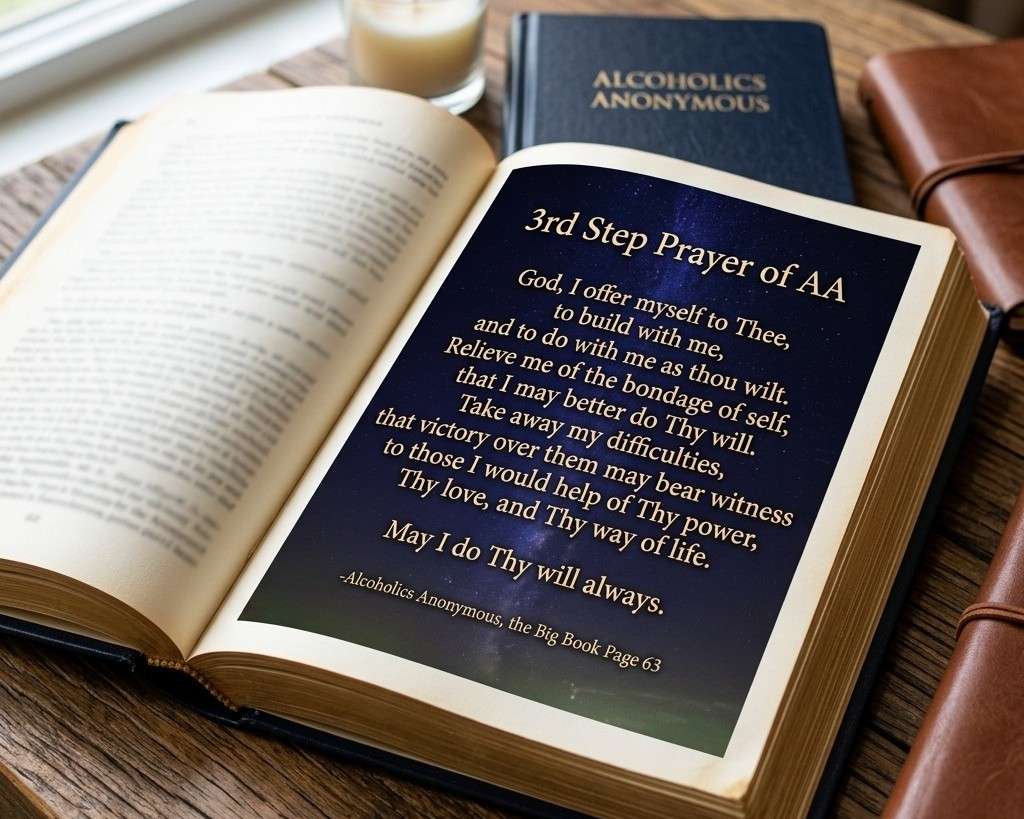
To truly benefit from this practice, we must look at what these phrases actually mean in daily life. Recovery is not just about stopping a behavior; rather, it is about changing how we interact with the world around us.
“Relieve me of the bondage of self.”
This is perhaps the most famous line in the entire text. In addiction, our world becomes very small because it is focused entirely on our needs and pain. Therefore, “bondage of self” refers to the prison of ego and fear. By praying this, you are asking for the ability to look outward rather than inward.
“That victory over them may bear witness.”
This phrase provides a crucial insight into the third step prayer meaning. Specifically, you are not asking for problems to vanish just to have an easy life. Instead, you are asking for the strength to overcome them so you can show others that recovery is possible. As a result, your struggle becomes a tool for service.
Why is Step 3 So Difficult?
The idea of “surrender” often feels like “giving up” to the newcomer. However, in third-step prayer AA circles, surrender is actually viewed as a way of winning. There are several reasons why this step feels challenging:
-
Fear of Loss of Control: We often think our “will” is keeping us safe when, in reality, it was leading us toward destruction.
-
Misunderstanding God: Many struggle with the word “God.” Nevertheless, in AA, this is a “God of your understanding,” which could be the universe or the group itself.
-
The Perfectionism Trap: Many feel they haven’t “surrendered” perfectly. In contrast, recovery is about progress rather than perfection.
How to Practice the Third Step Prayer AA
Fortunately, you do not need to be in a formal meeting to use this prayer. Many people incorporate it into their morning routine to set a positive tone. Here is how you can make it a part of your life:
-
Find a Quiet Space: First, create a moment of stillness before the day begins.
-
Say it with a Sponsor: It is a common tradition to say the prayer for the first time with a guide.
-
Personalize the Language: If the traditional words do not resonate, many use an alternative version with modern language.
-
Connect it to Action: After the prayer, ask yourself how you can be of service to someone else today.
The Long-Term Impact of Surrender
The step 3 prayer Alcoholics Anonymous advocates is not a one-time event; it is a daily practice. By consistently offering up your self-will, you begin to experience a new sense of freedom.
Indeed, statistics from decades of 12-step programs suggest that those who lean into these spiritual aspects have higher rates of long-term sobriety. This is because it shifts the burden of “staying sober” from your shoulders to a power greater than yourself.
4. FAQ Section
What if I don’t believe in God?
The “God” mentioned is a “Higher Power of your understanding.” For instance, many use the collective wisdom of the AA group as their power. The focus is simply on realizing you are not the center of the universe.
Do I have to say the prayer exactly as written?
No. While many prefer the traditional version, the “decision” is what matters most. Therefore, some people use their own words to express the same sentiment of surrender.
What happens after the third step prayer?
Step 3 is the “decision” step. Following this, Steps 4 through 11 are the actions you take to clear away the things blocking you. Consequently, Step 3 gives you the courage to start that hard work.