
An Irish blessing is far more than a pretty phrase. It is a living thread connecting you to generations of Celtic tradition—spoken at bedsides, weddings, gravesides, and every kind of doorstep in between. If you have ever heard “May the road rise to meet you,” you already know the warmth these words can carry. Throughout this guide, you will find the finest traditional and modern blessings, an explanation of their roots, and help in choosing exactly the right words for your moment.
What Makes an Irish Blessing Unique?
An Irish blessing is a short prayer or wish rooted in the Gaelic oral tradition of Ireland. Unlike formal liturgical prayer, these blessings tend to be informal, poetic, and deeply connected to the natural world—roads, wind, rain, stars, and hearth fires all appear as symbols of divine goodwill. Moreover, they speak directly to the person being blessed, which gives them an intimacy that formal prayers often lack.
Scholars of Celtic literature at University College Dublin trace the earliest known Gaelic blessings to early Christian manuscripts from the 6th to 8th centuries. In those manuscripts, monastic scribes blended pre-Christian reverence for nature with Christian devotion. Consequently, the result was a uniquely Irish voice: earthy, lyrical, and warmly human.
The Most Famous Irish Blessing: “May the Road Rise Up”
No conversation about this tradition is complete without the most recognized example of all. Known simply as the road blessing, it appears on greeting cards, church walls, and wedding programs across the world. Its enduring appeal lies in how naturally it moves from the physical—road, wind, sun, and rain—to the spiritual.
May the road rise to meet you.
>May the wind be always at your back.
>May the sun shine warm upon your face;
The rains fall soft upon your fields.
And until we meet again,
May God hold you in the palm of His hand.
— Traditional Irish blessing (Gaelic origin, translator unknown)
The original Gaelic phrase is “Go n-éirí an bóthar leat,” meaning “May the road rise with you.” The extended English version likely dates to the 19th-century Irish diaspora, when emigrants carried these words across oceans as a farewell gift from home. As a result, the blessing became embedded in Irish-American culture and eventually spread worldwide.
Traditional Irish Blessings for Good Luck
The Irish have always had a remarkable gift for wishing fortune upon others. A traditional blessing for good luck suits the start of a new job, a journey, an exam, or any fresh beginning. In each case, the sentiment is the same: may chance favor you wherever you go.
May your pockets be heavy and your heart be light.
May good luck pursue you each morning and night.
— Traditional Irish blessing for good luck
May the luck of the Irish lead to the happiest heights.
And the highway you travel on is lined with green lights.
— Modern Irish-American blessing
Notice how luck, in the Irish tradition, is never passive—instead, it is something that “pursues” you, that travels the same road you do. This active quality makes these blessings feel like a push forward rather than a vague wish.
An Irish Blessing for a Friend: Honouring Loyalty
Friendship is sacred in Irish culture. The Gaelic word “cara” (friend) carries a depth of loyalty that goes beyond casual acquaintance. Consequently, an old Irish blessing aimed at a friend acknowledges that bond with particular grace—not merely wishing good things, but promising continued presence and warmth.
May you have warm words on a cold evening.
a full moon on a night,
and a smooth road all the way to your door.
— Old Irish blessing
May good luck be your friend in whatever you do.
And may trouble always be a stranger to you.
— Traditional Gaelic blessing for a friend
Both are excellent choices for a card, a toast, or even a social media message. Short enough to memorize, yet meaningful enough to remember for years.
Irish Blessing for a Wedding: Celtic Tradition in Ceremony
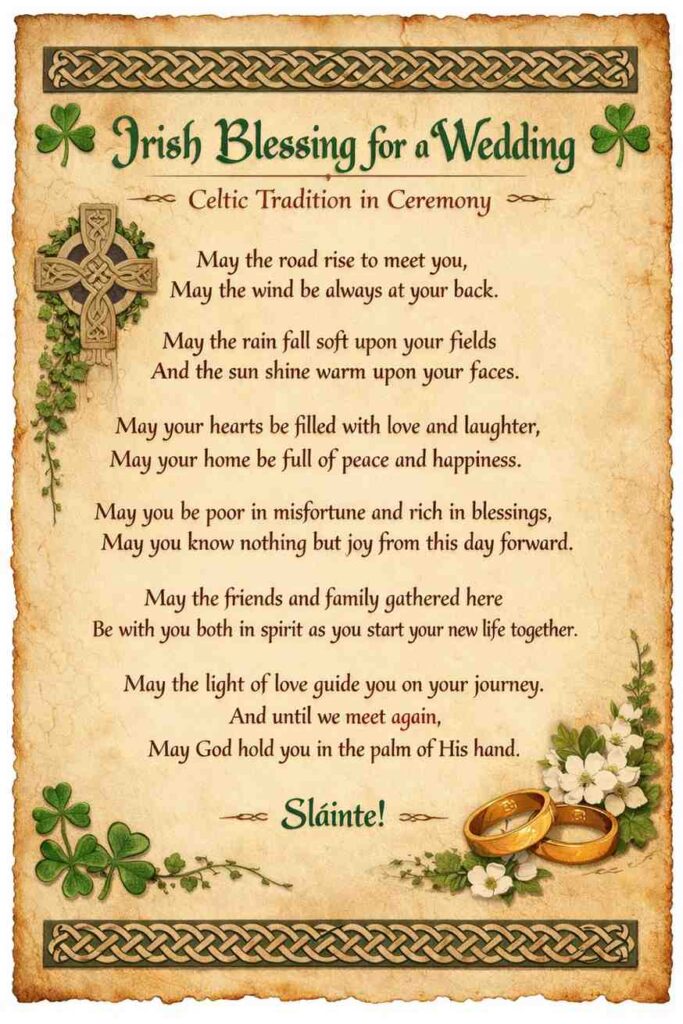
Among all occasions, the wedding is where a Celtic blessing truly shines. Couples across many cultural backgrounds choose these words for ceremony readings, invitations, and framed gifts. The reason is simple: no other tradition wraps love, luck, and longevity into language quite as elegantly.
May your mornings bring joy and your evenings bring peace.
>May your troubles grow less as your blessings increase.
>May the saddest day of your future
Be no worse than the happiest day of your past.
— Traditional wedding blessing
May you have the hindsight to know where you’ve been.
the foresight to know where you’re going,
and the insight to know when you’ve gone too far.
— Irish blessing (popular at wedding toasts)
The second blessing sits comfortably between a sincere wish and a knowing wink—perfect for a toast that draws a warm laugh before settling into something heartfelt.
Short Irish Blessings for Everyday Use
Not every moment calls for four stanzas. A short blessing can do the work of a paragraph in just one or two lines. Furthermore, brief blessings travel well — they fit a text message, a birthday card, or an Instagram caption without losing their weight.
- “May you be in heaven a full half hour before the devil knows you’re dead.”
- “May the wind always be at your back.”
- “Go raibh maith agat”—” May you have goodness” (a Gaelic blessing of thanks)
- “May your heart be light and your troubles few.”
- “May joy and peace surround you.”
Funny Irish Blessings: Wit Wrapped in Warmth
The Irish genius for dark humor finds its fullest expression in the funny blessing—a form that wraps a smile around a prayer. These work brilliantly for retirement parties, birthday roasts, or toasts among old friends, precisely because the humor disarms the room before the sentiment lands.
May those who love us love us.
And those who don’t love us —
May God turn their hearts.
And if He doesn’t turn their hearts,
May He turn their ankles.
So we’ll know them by their limping.
— Beloved Irish comic blessing, traditional
This works because it begins in genuine warmth and pivots to delightful mischief—a structure that reflects the Irish temperament itself. Indeed, the best funny blessings are only funny because the affection underneath them is completely real.
Irish Blessing for the Home: A Gift for Any Doorstep
Traditionally displayed on a wooden plaque, needlepoint, or printed canvas near the front door, a home blessing sanctified the threshold and invited good fortune into the household. Today, these words work equally well as a housewarming gift, a new business card, or a family reunion centerpiece.
May your home be filled with laughter,
May your pockets be filled with gold.
And may you have all the happiness
Your heart can hold.
— Traditional Irish home blessing
- Framed print as a housewarming gift
- Message inside a new home card
- Opening a new business or office space
- Family reunion or gathering centrepiece
Irish Blessing for St. Patrick’s Day and Birthdays
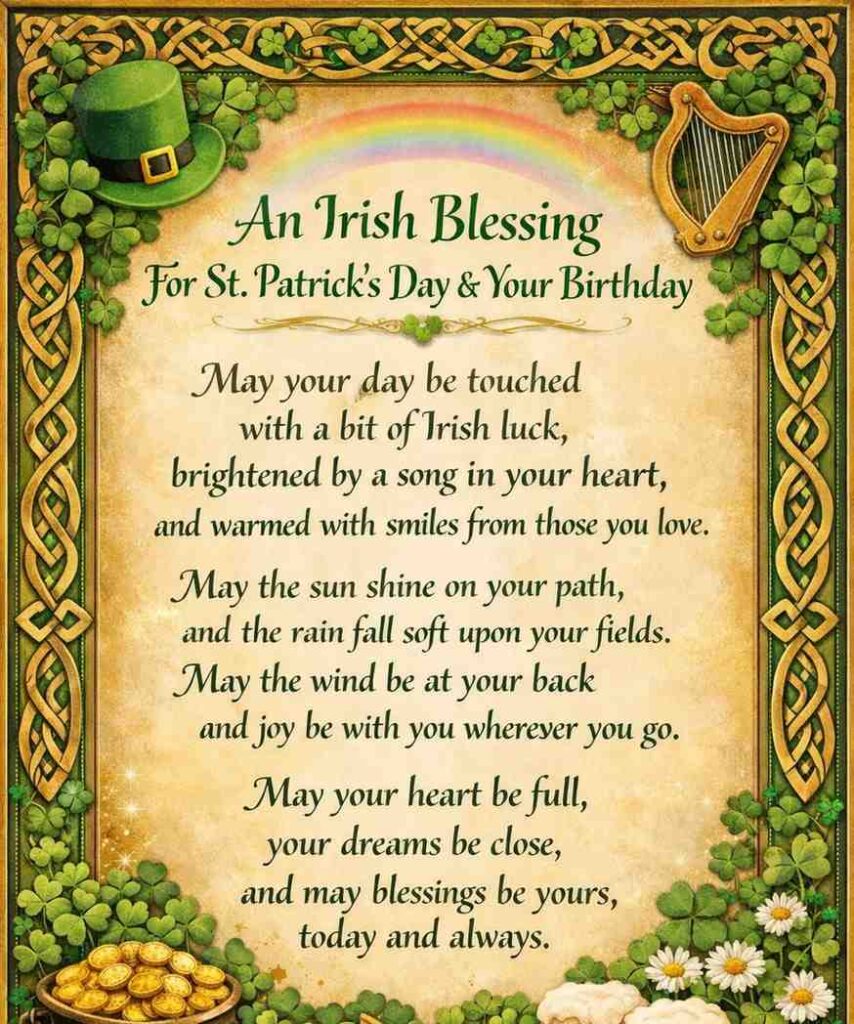
On St. Patrick’s Day, blessings flow as freely as the Guinness. Whether you are Irish by birth or by spirit, the day invites everyone to share in this verbal tradition. Similarly, a birthday is the perfect occasion for a short wish that combines celebration with genuine goodwill.
May you live as long as you want
and never want as long as you live.
— Classic Irish toast-blessing
Simple, generous, and impossible to argue with—this one works equally well at a St. Patrick’s Day gathering or a ninetieth birthday party.
How to Use Any Irish Blessing Authentically
You do not need Irish heritage to use these words; however, a little context always deepens their impact. Here are four practical tips for using any Irish prayer and blessing with confidence:
- Match the tone to the occasion. Solemn blessings suit funerals; joyful ones suit weddings; playful ones suit birthdays and toasts.
- Consider the Gaelic original. Even one Gaelic phrase adds authenticity and often sparks wonderful conversation.
- Speak it aloud. These blessings were oral before they were written. Reading them slowly reveals the rhythm the poet intended.
- Attribute honestly. Many are “traditional” and anonymous—avoid false attribution to famous poets.
💍Weddings🎂Birthdays🏠New home🍀St. Patrick’s Day✈️Send-off🌿Funerals
Above all, what makes an Irish blessing endure is that it does what all great language does: it takes the invisible—hope, love, luck, grief—and gives it a shape you can hold. Whether you choose a traditional Gaelic prayer, a short funny verse, or the famous road blessing, you carry forward a living tradition that has comforted and connected people for over a thousand years. Use these words generously. That is, after all, exactly what they were made for.
Frequently asked questions about Irish blessings
What is the most famous Irish blessing?
The most famous example is “May the road rise up to meet you,” known as the traditional road blessing. It originates from the Gaelic phrase “Go n-éirí an bóthar leat” and is widely used at farewells, weddings, and any moment of new beginning.
What is the difference between an Irish and a Celtic blessing?
An Irish blessing specifically originates from the Irish Gaelic tradition, while a Celtic blessing is broader, covering Wales, Scotland, Brittany, and other Celtic nations. Although the two overlap considerably in theme and imagery, Irish blessings carry the specific linguistic fingerprint of the Irish language.
Are Irish blessings religious?
Many traditional examples are Christian in origin, invoking God, saints, or divine protection. However, many others are secular in nature, referring only to nature, luck, and goodwill. As a result, you can easily find a blessing that suits both religious and non-religious occasions.
How do you say “blessing” in Irish Gaelic?
The Gaelic word for “blessing” is “beannacht” (pronounced BAN-akht). A common farewell phrase is “Beannacht Dé leat,” meaning “The blessing of God with you.” The plural form is beannachta. í.
Pingback: Happy Thanksgiving Blessings: Quotes, Prayers, Messages - thesundayblessings.com
I love how the traditional Irish blessing connects nature to spirituality. This blend of the physical and spiritual reminds me of the warmth found in an irish blessing, which often speaks directly to the person being blessed. The intimacy in these words is truly special.