
Nimrod in the Bible: The First World Leader and Mighty Hunter
Have you ever wondered who the first person ever was to claim the title of “king”? When we look back at the earliest records of human history, one name stands out with both mystery and power: Nimrod in the Bible. Specifically, the genealogical records of Genesis mention him as a “mighty hunter,” but his legacy goes much deeper than his skill with a bow. Furthermore, his story marks a pivotal shift in how human societies organized themselves after the Great Flood.
Who was Nimrod in the Bible?
Nimrod in the Bible was the son of Cush and the great-grandson of Noah. He is described as the first “mighty man” on earth and a “mighty hunter before the Lord.” He founded a vast kingdom in the land of Shinar, which included famous cities like Babel, Akkad, and Nineveh.
Exploring the Lineage of Nimrod in the Bible
To understand Nimrod, we must first look at his family origins. According to the Table of Nations found in Genesis 10, Nimrod descended from Ham, one of Noah’s three sons. Specifically, his father was Cush, who led the Hamitic line into Africa and parts of the Middle East.
Consequently, this lineage is significant because it places Nimrod at the center of post-flood expansion. While most of his relatives settled into various regions as tribal heads, Nimrod took a different path by building an empire. Because the Bible notes that “Cush begot Nimrod; he began to be a mighty one on the earth” (Genesis 10:8), we see the birth of individual political power.
What Does “Mighty One” Mean?
The Hebrew word used here is “gibbor,” which often refers to a hero, a giant, or a warrior. Specifically, it implies someone who has gathered immense strength and influence. Before Nimrod, the Bible focuses largely on families and tribes. However, Nimrod changed this dynamic by exerting political and military dominance over others.
Why Nimrod in the Bible is Called a “Mighty Hunter”
One of the most famous descriptions of Nimrod is that he was a mighty hunter before the Lord. At first glance, this sounds like a compliment. You might assume he was simply a skilled provider for his people. Nevertheless, many biblical scholars and ancient traditions suggest a more complex meaning behind this phrase.
A Hunter of Animals or a Hunter of Men?
While Nimrod may have been a literal hunter of wild beasts, many commentators suggest he was a “hunter of souls” or a “hunter of men.” Furthermore, the phrase “before the Lord” (liphne YHWH) can be interpreted in several ways:
In the presence of God: This implies God witnessed his greatness.
In defiance of God: Many Jewish traditions, including those of Josephus, argue that “before” actually meant “against” or “in the face of.”
As a result, Nimrod serves as the archetype of a ruler who seeks to lead people away from dependence on God and toward dependence on a human government. Because he was “mighty,” he possessed the charisma to pull people into his own vision of the world.
The Kingdom of Nimrod in the Bible: Shinar and Babel
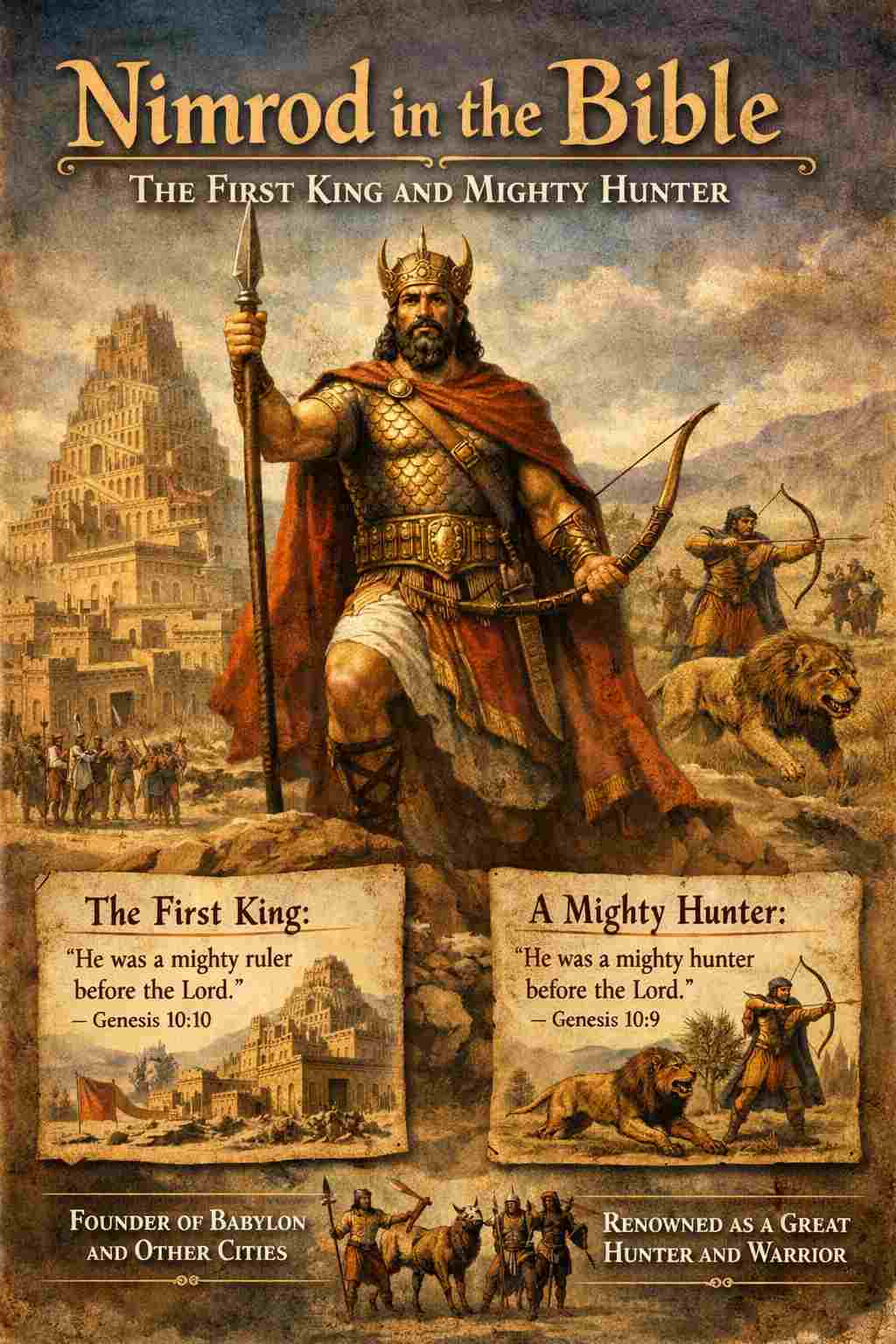
Nimrod was not just a hunter; he was a master builder and an urban visionary. The Bible credits him with establishing the first major civilization in the land of Shinar. Moreover, his influence extended across Mesopotamia, forming the foundation of what would become the Babylonian and Assyrian empires.
The Cities of Nimrod
According to Genesis 10:10-12, the beginning of his kingdom included:
Babel: The site of the infamous Tower of Babel.
Erech and Akkad: Major hubs of early Sumerian culture.
Calneh: Another significant city in Shinar.
In addition to these, Nimrod went into Assyria and built Nineveh, which later became the capital of the Assyrian Empire. This geographical reach shows that Nimrod pioneered globalization and centralized power.
Did Nimrod in the Bible build the Tower of Babel?
Although the Bible does not explicitly state that Nimrod gave the direct order to build the Tower of Babel in Genesis 11, historical tradition strongly links him to the project. Specifically, the Jewish historian Flavius Josephus wrote that Nimrod incited the people to such an affront against God.
Why Did the People Build the Tower?
The people said, “Let us build ourselves a city and a tower whose top is in the heavens; let us make a name for ourselves” (Genesis 11:4). Consequently, the tower represented human pride and the desire to reach the heavens without God’s help.
However, God intervened by confounding their languages. This act forced the people to scatter across the earth, effectively ending Nimrod’s dream of a single, unified world empire under his control. Ultimately, the story of Babel serves as a warning about the dangers of human-centric power.
Historical and Archeological Context of Nimrod in the Bible
Many historians attempt to link Nimrod in the Bible with known historical figures from ancient Mesopotamia. For instance, some believe Nimrod is a biblical reflection of Sargon of Akkad, the first ruler to unite the Sumerian and Akkadian peoples.
Comparing Nimrod to Ancient Heroes
Sargon of Akkad: Like Nimrod, Sargon built a massive empire and maintained high military prowess.
Gilgamesh: The legendary King of Uruk (Erech) is often depicted as a “mighty man” who fought beasts and sought immortality.
Enmerkar: A Sumerian king who, according to legend, built a great temple and experienced a “confusion of tongues” among his people.
Regardless of the specific historical match, Nimrod represents the real-world shift toward monarchies and city-states that occurred in the Bronze Age. Furthermore, his presence in the Bible provides a crucial bridge between the flood of Noah and the rise of the great world empires.
FAQ: Common Questions About Nimrod in the Bible
1. Was Nimrod a good or bad person in the Bible?
While the Bible is somewhat neutral in its direct language, the context of his kingdom (Babel) and his lineage usually paint him in a negative light. Tradition views him as a rebel against God.
2. What is the meaning of the name “Nimrod”?
The name is often associated with the Hebrew word “marad,” which means “to rebel.” This supports the view that his life was defined by a rebellion against divine authority.
3. Did Nimrod build the Tower of Babel?
The Bible says Babel was the beginning of his kingdom. While it doesn’t name him as the architect, ancient historical texts like the Antiquities of the Jews name him as the leader behind the project.
4. How is Nimrod related to Noah?
Nimrod was the son of Cush, who was the son of Ham, who was the son of Noah. This makes Nimrod Noah’s great-grandson.
Pingback: Adonai Meaning in the Bible – A Simple 5‑Minute Guide - thesundayblessings.com