
50 Most Meaningful Christmas Bible Verses to Read This Holiday Season
The most beloved Christmas Bible verses come from the books of Luke, Isaiah, Matthew, and John—and together, they tell the full story of Christ’s birth, from ancient prophecy to the angels’ joyful announcement. Whether you’re looking for scriptures to read at a Christmas Eve service, share on a card, or reflect on quietly at home, this guide covers every verse you need—organized by theme and explained with context so they genuinely speak to your heart.
I’ve spent years studying Scripture and leading Advent devotionals, and every December I’m reminded how fresh and powerful these passages remain. So let’s dig in together.
What Are Christmas Bible Verses?
Christmas Bible verses are scriptures that relate to the birth of Jesus Christ, including Old Testament prophecies that foretold His coming and New Testament accounts of the nativity. They span books like Isaiah, Micah, Luke, Matthew, and John, and they form the theological and narrative backbone of the Christian Christmas celebration.
The Core Nativity Story: Luke 2 and Matthew 2
Without a doubt, the Gospel of Luke contains the most detailed account of Christ’s birth. Therefore, it’s where most Christmas readings begin.
Luke 2:10-11 — The Angel’s Announcement
“Do not be afraid. I bring you good news that will cause great joy for all the people. Today in the town of David, a Savior has been born to you; he is the Messiah, the Lord.”
This is the heart of Christmas in a single breath. Notice that the angel specifically says “all the people”—not just a tribe, a nation, or a religion. The joy of this birth, according to Scripture, is universal. Furthermore, the phrase “do not be afraid” appears repeatedly throughout the nativity narrative, which is worth pausing on. Whenever God does something extraordinary, He leads with reassurance.
Luke 2:6-7 — The Birth Itself
“While they were there, the time came for the baby to be born, and she gave birth to her firstborn, a son. She wrapped him in cloths and placed him in a manger, because there was no guest room available for them.”
The simplicity of this verse is staggering. The Creator of the universe arrived not in a palace but in a stable. As a result, Christmas has always carried this countercultural edge—greatness wrapped in humility.
Matthew 1:23 — Fulfilled Prophecy
“The virgin will conceive and give birth to a son, and they will call him Immanuel (which means ‘God with us’).”
Matthew quotes Isaiah 7:14 here, connecting the Old and New Testaments in a single verse. Consequently, this is one of the most cited Christmas Bible verses in both sermons and holiday cards alike.
Old Testament Christmas Prophecies That Point to Jesus
One of the most compelling aspects of the Christmas story is how thoroughly it was anticipated. Centuries before Bethlehem, prophets foretold specific details about the Messiah’s birth—and those predictions came true with remarkable precision, according to biblical scholars at institutions like Dallas Theological Seminary and The Gospel Coalition.
Isaiah 9:6 — The Most Famous Christmas Prophecy
“For to us a child is born, to us a son is given, and the government will be on his shoulders. And he will be called Wonderful Counselor, Mighty God, Everlasting Father, Prince of Peace.”
Written roughly 700 years before Jesus was born, this verse is stunning in its specificity. In fact, composer George Frideric Handel immortalized it in the Messiah oratorio in 1741, and it remains one of the most performed classical works in the world every December. The four names given here — Wonderful Counselor, Mighty God, Everlasting Father, Prince of Peace — each describe a different facet of who Jesus is.
Micah 5:2 — The Birthplace Foretold
“But you, Bethlehem Ephrathah, though you are small among the clans of Judah, out of you will come for me one who will be ruler over Israel, whose origins are from of old, from ancient times.”
This prophecy named the very town of Jesus’ birth more than 700 years in advance. As a result, when the Magi in Matthew 2 ask where the Messiah is to be born, the chief priests quote Micah 5:2 immediately. It’s a breathtaking moment of prophetic fulfillment.
Isaiah 7:14 — The Virgin Birth
“Therefore, the Lord himself will give you a sign: The virgin will conceive and give birth to a son, and will call him Immanuel.”
Matthew 1:23 quotes this directly, making it one of the most important connective threads between the two testaments. Additionally, the name “Immanuel” — God with us — captures the entire theology of Christmas in two words.
Christmas Bible Verses About Light and Darkness
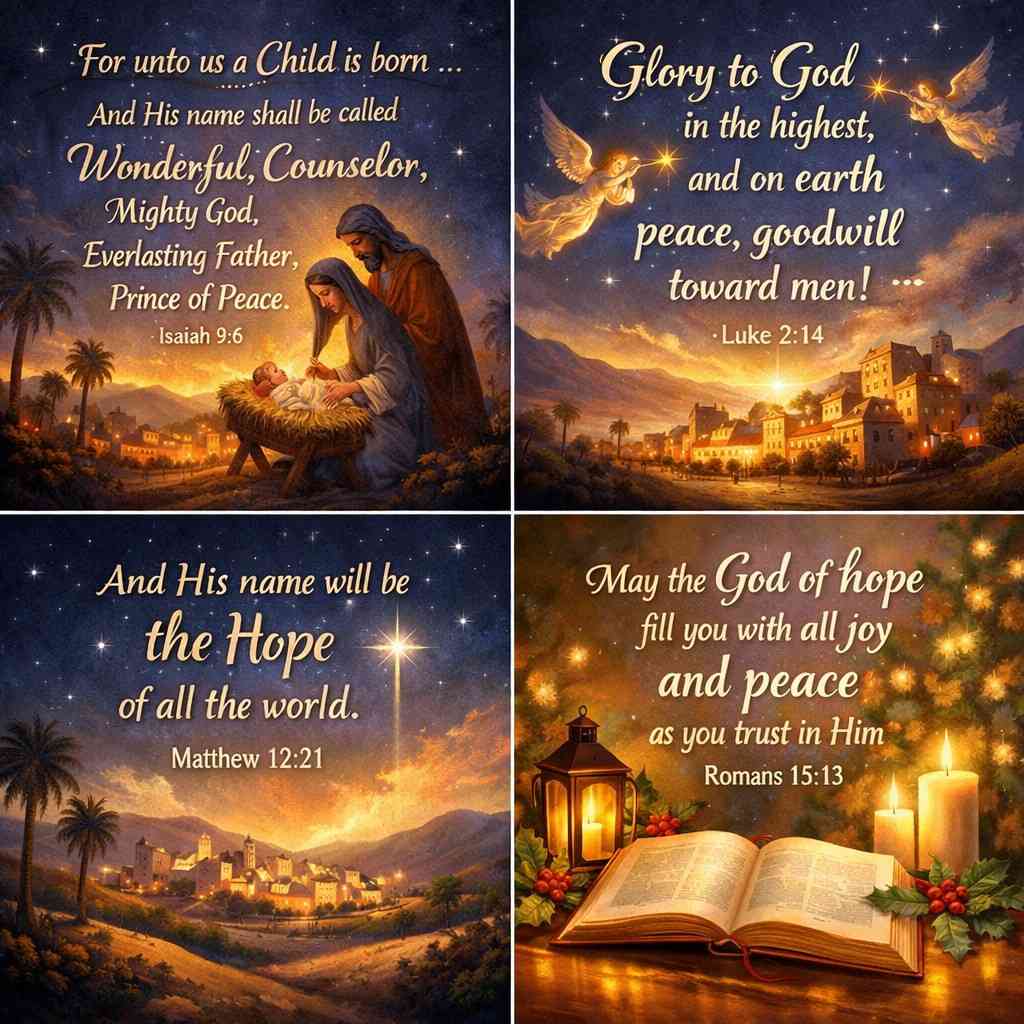
Interestingly, many of the most powerful Christmas scriptures use the metaphor of light piercing darkness. This is especially meaningful during the winter season in the Northern Hemisphere, when days are shortest and nights are longest.
John 1:1-5, 14 — The Poetic Prologue
“In the beginning was the Word, and the Word was with God, and the Word was God… In him was life, and that life was the light of all mankind. The light shines in the darkness, and the darkness has not overcome it… The Word became flesh and made his dwelling among us.”
John’s Gospel doesn’t begin with a manger or a stable. Instead, it takes us to the very beginning of creation. Consequently, John frames the Christmas story as a cosmic event, not merely a historical one. The phrase “the darkness has not overcome it” is one of the most comforting sentences in all of Scripture.
Isaiah 9:2 — Light for Those in Darkness
“The people walking in darkness have seen a great light; on those living in the land of deep darkness, a light has dawned.”
This verse sits just four verses before the famous Isaiah 9:6 prophecy, and together they form a beautiful unit. First, the problem: people are in darkness. Then, the solution: a great light dawns. Moreover, this is exactly the pattern the Christmas story follows.
Matthew 4:16—Matthew Quotes Isaiah
“The people living in darkness have seen a great light; on those living in the land of the shadow of death, a light has dawned.”
Matthew quotes Isaiah 9:2 again as Jesus begins His public ministry, thus reinforcing that the Light of the World motif runs throughout the entire Gospel narrative, from birth to ministry.
Christmas Bible Verses About Peace and Hope
Beyond the angels and the manger, Christmas Bible verses consistently return to the themes of peace and hope. These are exactly what people are searching for during the holiday season.
Luke 2:14 — Peace on Earth
“Glory to God in the highest heaven, and on earth peace to those on whom his favor rests.”
The angels didn’t just announce a birth. Furthermore, they declared a peace—a shalom—that Jesus came to bring. This is arguably the most quoted Christmas verse in history.
Romans 15:13 — A Prayer for Hope
“May the God of hope fill you with all joy and peace as you trust in him, so that you may overflow with hope by the power of the Holy Spirit.”
While not a nativity verse per se, Romans 15:13 is widely used during the Advent season because it captures the spirit of what Christmas promises. Therefore, it frequently appears in Christmas cards and holiday devotionals.
John 3:16-17 — The Reason for the Season
“For God so loved the world that he gave his one and only Son, that whoever believes in him shall not perish but have eternal life. For God did not send his Son into the world to condemn the world, but to save the world through him.”
No list of Christmas Bible verses is complete without John 3:16. This is the “why” behind the entire Christmas story. As a result, it’s the verse that ties every ornament, carol, and nativity scene together into one coherent message: God loves you, and He came to be with you.
Christmas Bible Verses Organized by Theme (Quick Reference Table)
| Theme | Verse | Book |
|---|---|---|
| The Birth | Luke 2:6-7 | New Testament |
| Angels’ Announcement | Luke 2:10-11 | New Testament |
| Prophecy | Isaiah 9:6 | Old Testament |
| Light in Darkness | John 1:5 | New Testament |
| Peace | Luke 2:14 | New Testament |
| Hope | Romans 15:13 | New Testament |
| God With Us | Matthew 1:23 | New Testament |
| Love | John 3:16 | New Testament |
| Birthplace | Micah 5:2 | Old Testament |
| Wise Men | Matthew 2:10-11 | New Testament |
How to Use Christmas Bible Verses This Holiday Season
Here’s a simple step-by-step approach to incorporating these scriptures into your Christmas traditions:
- Choose an Advent reading plan. Organizations like the YouVersion Bible App offer free Advent devotionals that walk you through one Christmas verse per day for the 25 days leading up to Christmas. Start on December 1st for the richest experience.
- Read Luke 2:1-20 aloud as a family on Christmas Eve. This is a centuries-old Christian tradition, and it grounds the celebration in its original meaning. Even 10 minutes of scripture before gifts makes a memorable impression on children.
- Write a key verse on Christmas cards. Isaiah 9:6, Luke 2:10-11, or John 3:16 are all excellent choices. A handwritten verse adds personal warmth and a spiritual dimension that a generic greeting simply can’t match.
- Use a verse as a table centerpiece. Print or write out Luke 2:14 on a small card and place it at the center of your Christmas dinner table as a conversation starter.
- Memorize one verse each year. Start with something short, like John 1:14 (“The Word became flesh and made his dwelling among us”). Over time, you’ll build a treasury of scripture that stays with you long after the decorations come down.
Christmas Bible Verses for Kids
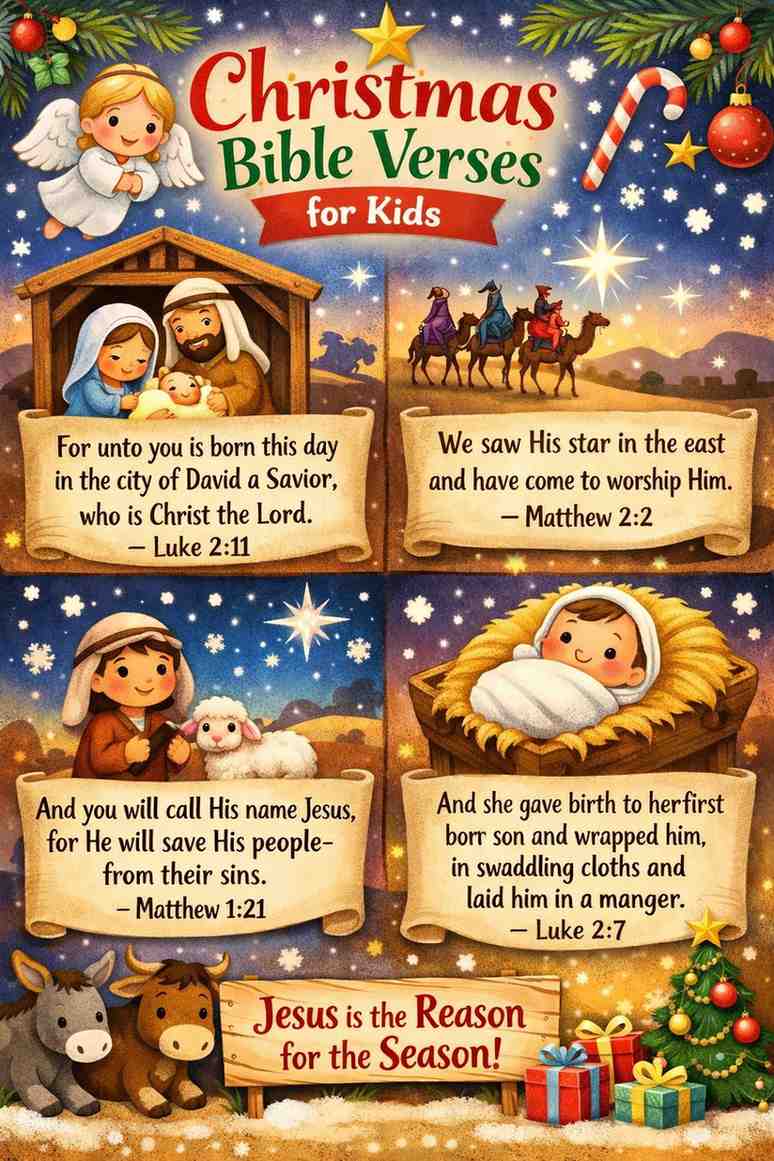
If you’re introducing children to the Christmas story, these are the most accessible and memorable verses to start with.
Luke 2:10-11 — Perfect for Young Children
The angel’s words are short, direct, and full of joy. Additionally, the contrast between the angel’s grandeur and the simple message makes it a natural conversation starter with kids: “Why would an angel be so excited about a baby?”
Matthew 2:10 — The Joy of the Magi
“When they saw the star, they were overjoyed.”
This short verse is easy for children to memorize, and moreover, it captures genuine emotion—these wise men traveled hundreds of miles and, upon arriving, were overjoyed. That kind of enthusiasm for Jesus is a wonderful thing to model for young readers.
FAQ: Christmas Bible Verses
What is the most famous Christmas Bible verse?
Luke 2:10-11 and John 3:16 are generally considered the most famous Christmas Bible verses in the United States. Luke 2:10-11, in which the angel announces the birth of Jesus to the shepherds, appears in virtually every Christmas Eve service nationwide. John 3:16 is cited as the theological summary of why Jesus came.
Where in the Bible is the Christmas story found?
The Christmas story is primarily found in Luke 2:1-20 and Matthew 1:18-2:23. Luke emphasizes the shepherds and the manger, while Matthew focuses on the Magi and the fulfillment of prophecy. Additionally, John 1:1-14 provides a poetic theological prologue to the nativity.
Are there Christmas verses in the Old Testament?
Yes, absolutely. Several Old Testament prophecies are considered Christmas Bible verses because they foretell Jesus’ birth. The most important include Isaiah 9:6, Isaiah 7:14, and Micah 5:2, all of which were written centuries before Jesus was born and are directly quoted in the New Testament nativity accounts.
What Bible verse do Christians read on Christmas Eve?
Most Christian churches read Luke 2:1-20 on Christmas Eve. This passage covers the journey to Bethlehem, the birth in the manger, the angels’ announcement to the shepherds, and the shepherds’ visit—making it the most complete single account of the nativity.
What does the Bible say about Christmas trees and decorations?
The Bible does not specifically mention Christmas trees. Some point to Jeremiah 10:1-5 as a possible reference, though most biblical scholars, including those at the ESV Study Bible editorial team, note that this passage refers to carved idols, not Christmas trees. Christmas as a holiday is not described in the New Testament; however, the birth of Jesus, which it commemorates, certainly is.
Pingback: Bible Verses About Nature: Finding God in Creation - thesundayblessings.com
Pingback: What is Jesus Real Name? The Hidden History and Meaning - thesundayblessings.com
Pingback: Adonai Meaning in Bible: Lord & Master – Complete Guide -