
Charlotte Means Biblically: 7 Powerful Truths Revealed
If you’ve searched what Charlotte means biblically, you’re likely one of two people: an expectant parent weighing a name for your daughter or someone named Charlotte curious whether Scripture has anything to say about it.
Here’s the short, honest answer: Charlotte does not appear anywhere in the Bible. It’s not a Hebrew, Greek, or Aramaic name found in any biblical genealogy or narrative. But that doesn’t mean the name is spiritually empty — its meaning, “free woman” or “strong woman,” lines up with one of the most repeated themes in Scripture: freedom found in God.
This guide breaks down exactly what Charlotte means biblically, which Bible verses connect to it, and why so many Christian parents still choose it—without stretching the truth about what is and isn’t in the Bible.
What Charlotte Means Biblically: Origin and Definition
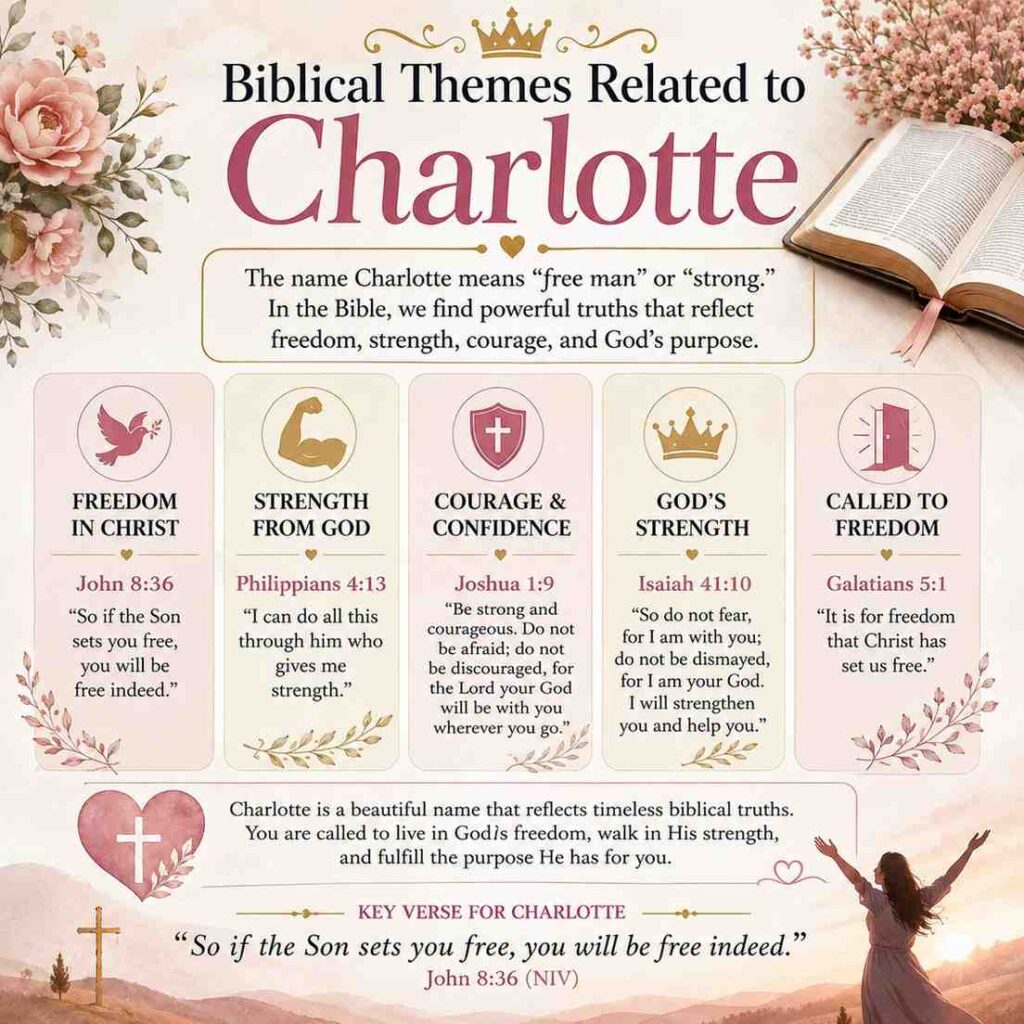
Charlotte isn’t a biblical name in the literal sense—it doesn’t trace back to Hebrew or Greek scripture. It’s the feminine form of Charles, which comes from the Old French Charlot, rooted in the Germanic word “karl,” meaning “free man” or “man of the people” (see Behind the Name’s etymology entry for the full linguistic history). As a feminine form, Charlotte carries the meaning “free woman.”
So when people ask what Charlotte means biblically, they’re really asking a thematic question, not a textual one: does the concept behind Charlotte’s name—freedom—show up in Scripture? It does, repeatedly, as a central idea about what happens to a person once they turn to God.
Origin of the Name Charlotte
| Detail | Information |
|---|---|
| Name | Charlotte |
| Root | Old French Charlot → Germanic Karl |
| Literal meaning | Free woman / strong woman |
| First widespread use | European royal courts, 17th–18th century |
| Modern popularity | Consistently a top-10 girl’s name in the US, UK, and Australia |
The name gained prominence through royalty—most notably Queen Charlotte of Mecklenburg-Strelitz (1744–1818), wife of King George III, known for supporting education and the abolition of the slave trade.
Bible Verses Connected to What Charlotte Means Biblically
None of these verses mention Charlotte by name—they’re connected by theme, not by text. Being upfront about that distinction matters if you want an accurate answer, not just an inspiring one. You can cross-reference each verse directly on Bible Gateway or Bible Hub.
| Theme | Verse | Connection |
|---|---|---|
| Freedom in Christ | Galatians 5:1 | Paul writes that Christ set believers free so they would stand firm and not return to bondage — the clearest scriptural echo of “free woman.” |
| Freedom through the Son | John 8:36 | Jesus teaches that freedom given by the Son is complete freedom, not a partial or symbolic one. |
| Strength and dignity | Proverbs 31:25 | Describes a woman clothed in strength and dignity who faces the future without fear — often linked to Charlotte’s “strong woman” meaning. |
| Identity in God | Psalm 139:14 | Speaks to being fearfully and wonderfully made, a common verse for name-meaning reflections. |
| Freedom as inheritance | Galatians 4:31 | Paul contrasts children of the “slave woman” with children of the “free woman” as a metaphor for grace over law. |
Biblical Women Who Reflect What Charlotte Means Biblically
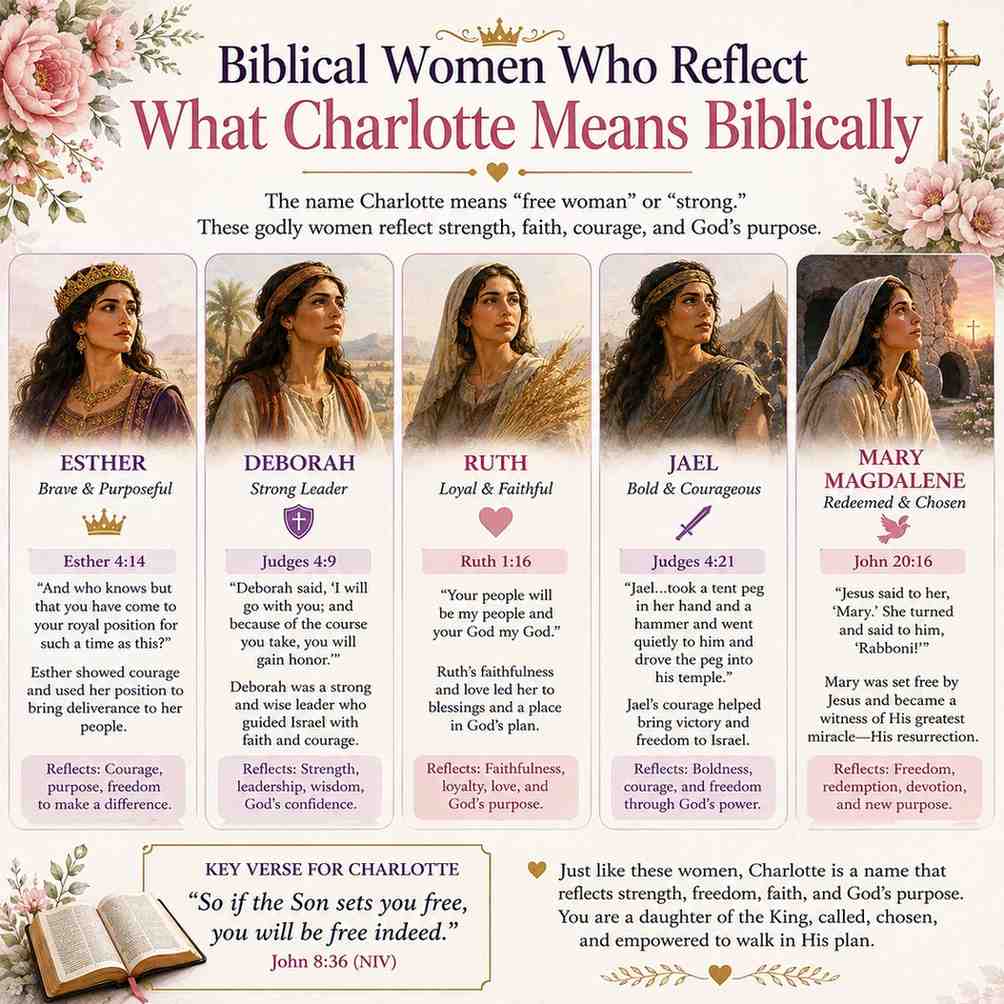
Since Charlotte itself isn’t in Scripture, here are the women whose stories most closely mirror what the name represents:
- Deborah (Judges 4–5) — a judge and prophetess who led Israel with authority rarely granted to women in her era, reflecting the “strength” side of Charlotte’s meaning.
- Esther—risked her position and safety to save her people, reflecting courage paired with humility.
- Mary Magdalene — freed from spiritual bondage and became one of the first witnesses to the resurrection, reflecting the “freedom” core of the name most directly.
These aren’t claims that Charlotte is biblical—they’re simply the closest scriptural parallels, which is a fair distinction most name-meaning pages skip.
Is Charlotte a Good Christian Name?
Yes—with an important caveat. A name doesn’t need to appear in the Bible to be a meaningful choice for a Christian family. Historically, very few names in wide use today (Emma, Grace, Olivia, and Charlotte) are directly biblical. What matters more to many parents is whether a name’s meaning and the character it evokes align with values they want to pass on.
Two well-known Christian women named Charlotte reflect this well:
- Charlotte Elliott (1789–1871) wrote the hymn “Just As I Am,” used in countless revivals including Billy Graham’s crusades.
- Charlotte “Lottie” Moon (1840–1912) was a missionary to China for nearly four decades; the Southern Baptist Convention’s annual Christmas mission offering is named after her.
If you’re exploring more name meanings for your family, see our related guide on the biblical meaning of Grace or the biblical meaning of William.
Charlotte Name Variants
If you’re weighing Charlotte against similar options, here’s how common variants compare:
| Variant | Origin/Note |
|---|---|
| Carlota | Spanish/Portuguese form |
| Charlize | South African variant, popularized by actress Charlize Theron |
| Lottie | English nickname form |
| Carlotta | Italian form |
| Karla / Carla | Feminine forms closer to the original Germanic root |
Frequently Asked Questions: What Charlotte Means Biblically
Does Charlotte appear in the Bible?
No. Charlotte is not found in the Old or New Testament in any translation. What Charlotte means biblically is thematic (freedom, strength), not textual.
What does the name Charlotte mean?
Charlotte means “free woman” or “strong woman,” derived from the Germanic word “karl” through Old French.
What Bible verse best explains what Charlotte means biblically?
Galatians 5:1 and John 8:36 are the two most commonly cited verses, both centered on the theme of freedom in Christ.
Is Charlotte a religious name?
It’s not derived from a religious source—its origin is Germanic/Old French, not Hebrew or Greek. Its popularity among Christian families comes from its meaning aligning with biblical themes, not from a scriptural origin.
What’s the spiritual meaning of Charlotte?
Many interpret it as symbolizing freedom, inner strength, and dignity—themes drawn from how the name’s literal meaning parallels biblical teaching on freedom through faith.