
Adonai in Hebrew: What This Name of God Actually Means — and Why Christians Should Know It
Most Christians have heard the word “Adonai” in Hebrew in a worship song, maybe during a sermon series on the names of God or somewhere in the background of a liturgical prayer. But if you asked most churchgoers to explain what it actually means, you’d probably get “Lord” and then a shrug.
That’s not their fault. English Bibles translate it as “Lord,” and we move on. But something gets lost in that translation. The Hebrew word sitting behind that single English syllable has centuries of theological weight, grammatical nuance, and historical drama attached to it—and understanding it properly changes how you read the Old Testament, how you understand who Jesus claimed to be, and honestly, how you approach prayer.
The Linguistic Roots of Adonai in Hebrew
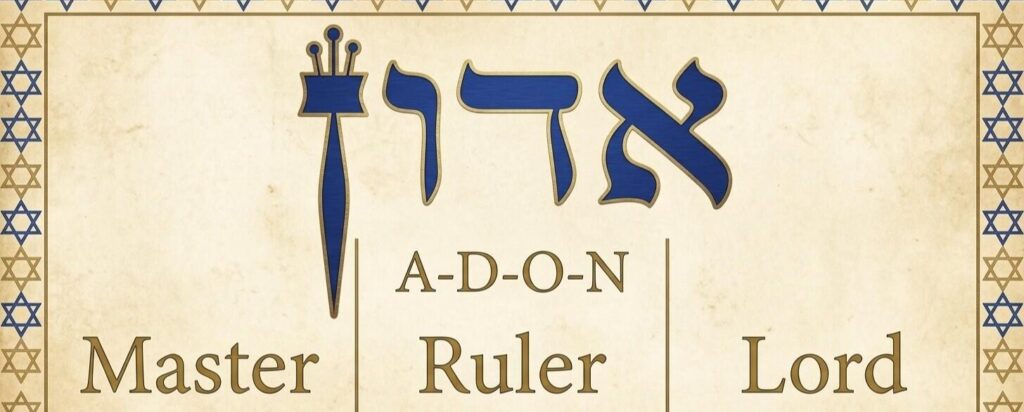
To understand what “Adonai” in Hebrew means, we must first look at its singular root form, which is “Adon” (אָדוֹן).
In ancient Hebrew, “adon” means a master, a lord, an owner, or someone holding legitimate authority over someone else. This was a word used in everyday, secular life. For instance, when Sarah refers to Abraham as her master, or when a servant speaks to his king, the word used is “adon.” It implies a vertical relationship. One person holds the right to direct, protect, and command. Meanwhile, the other person owes loyalty and service.
However, when we look at the complete title “Adonai” in Hebrew, two fascinating grammatical changes happen. These shifts elevate this everyday term into a unique divine title.
1. The Plural of Majesty (Pluralis Excellentiae)
First, the suffix of the word changes it to a plural form. Grammatically, this change isn’t numerical. Therefore, it does not mean “lords” in a plural sense. Instead, it is what Hebrew scholars call the “plural of majesty” or “plural of excellence.”
In biblical Hebrew, pluralizing a noun can magnify its intensity. Additionally, it can express absolute fullness. By rendering the word in the plural, the text emphasizes that God isn’t just a master among many. Rather, He is the ultimate, absolute summation of all lordship and authority.
2. The Possessive Suffix
Second, the ending “-ai” functions as a first-person possessive suffix meaning “my.” Translated literally, the term means “My Lords.”
Over time, this specific grammatical structure became used exclusively for the Creator. While someone might call a human ruler adon or adoni (“my lord”), the exact vocalization of Adonai became reserved solely for God. As a result, it blends absolute cosmic authority with personal, covenantal relationship. He is the universal Ruler, yet His people can look to Him and say, “My Lord.”
The Scribal Shift: Adonai and the Tetragrammaton
You cannot fully understand why “Adonai” in Hebrew appears where it does without looking at how ancient scribes treated the most holy name of God. This personal name is the Tetragrammaton (יהוה), typically transliterated as YHWH or Yahweh.
In Jewish tradition, particularly following the Babylonian exile, a deep reverence grew around speaking the personal name YHWH aloud. To avoid taking the name of the Lord in vain, rabbis enacted a rule of oral substitution known as “Qere” (what is read) versus “Ketiv” (what is written).
Consequently, whenever a reader came across the four letters יהוה in the biblical text, they would not pronounce them. Instead, they spoke the word Adonai aloud to protect the sacred name.
Centuries later, the Masoretes added vowel points to the consonant-only Hebrew text. During this process, they did something ingenious. They took the vowel points belonging to Adonai and superimposed them onto the consonants of YHWH.
This acted as a visual speed bump for the reader. Therefore, it reminded them to say “Adonai” instead of pronouncing the sacred name. When early Christian translations encountered these hybrid words, they translated YHWH as “CORE LORD” (all caps) and Adonai as “Lord” (lowercase mixed).
Comparing Adonai, Yahweh, and Elohim
The Hebrew Bible uses three primary names for God regularly. Each reveals a distinct aspect of His nature and actions in history.
| Hebrew Name / Title | English Translation Equivalent | Theological Focus |
| Elohim (אֱλֹהִים) | God | The Creator & Judge: Displays God’s ultimate power, cosmic transcendence, and position as ruler over the physical universe. |
| Yahweh / YHWH (יהוה) | THE LORD | The Covenant Partner: God’s personal, self-existent, uncaused name. It represents His faithfulness, presence, and relational intimacy with Israel. |
| Adonai (אָדֹנָי) | Lord | The Master & Provider: Emphasizes absolute authority, ownership, and the duty of service. It demands human obedience while promising protection. |
Consider how these names interact in scripture. Elohim tells us what God is—He is the supreme deity. Meanwhile, Yahweh tells us who He is—the personal God who enters into covenants with people. Finally, “Adonai” in Hebrew tells us what our relationship to Him looks like—He is our rightful master, and we are His servants.
Why Adonai in Hebrew Matters to Christian Theology

For Christians, the significance of “Adonai” in Hebrew directly connects to how the New Testament describes Jesus Christ.
When the Hebrew Bible was translated into Greek around the 2nd and 3rd centuries BC, the translators used the Greek word “Kyrios” (Κύριος) to translate both YHWH and Adonai. “Kyrios” means lord, master, or owner. Therefore, it carries the same semantic weight as Adon.
When Jesus arrived on the scene, the apostles began writing the books of the New Testament. Crucially, they explicitly chose the word “Kyrios” to describe Jesus.
When Paul writes in Romans 10:9 that you must confess Jesus is Lord, he is using this exact linguistic bridge. To a first-century ear steeped in the scriptures, calling Jesus Kyrios was a direct link to Adonai (Hebrew).
Consequently, the early Church was making a bold theological declaration. They stated that the authority, reverence, and lordship reserved exclusively for the God of Israel belonged entirely to Jesus Christ.
Frequently Asked Questions: Adonai in Hebrew
What does Adonai mean literally?
Literally, Adonai translates to “my lords.” It utilizes a plural of majesty joined with a first-person possessive suffix. In everyday use, it means “The Supreme Lord” or “My Sovereign Master.”
Is Adonai God’s actual personal name?
No, it is not. God’s personal name, given to Moses at the burning bush, is the Tetragrammaton, YHWH. Adonai is a title that denotes authority, governance, and a master-servant relationship. Scribes used it out of deep reverence to replace the personal name during public reading.
Why do some Bibles say “Lord GOD” instead of “Lord Lord”?
Sometimes the Hebrew text places Adonai and YHWH right next to each other. Reading it aloud as written would mean saying “Adonai Adonai.” To avoid this repetition, scribes vocalized the passage as Adonai Elohim (“Lord God”). Modern English translations honor this by rendering the phrase as “Lord GOD.” They use all capitals for “GOD” to let you know that the underlying word is actually the Tetragrammaton YHWH.