
Jehovah Jireh: God My Provider — Meaning, Bible Verses & Prayer
Have you ever been in a place where you didn’t know how your next bill would be paid, where your next meal would come from, or how a seemingly impossible situation would ever be resolved? If so, you are not alone — and more importantly, you are not forgotten. The Bible gives us a name for God that speaks directly into that moment of desperate need: Jehovah Jireh.
This ancient Hebrew name, first spoken by Abraham on a mountaintop in Moriah, carries a promise that has comforted believers for thousands of years. It means the Lord will provide. Not “The Lord might provide.” Not “The Lord sometimes provides.” The Lord will provide.
In this article, we will explore the full meaning of Jehovah Jireh, the powerful story behind this name, key Bible verses about God as our Provider, and prayers you can use today to anchor your faith in His provision.
Jehovah Jireh. What Does This Name of God Actually Mean?
The name Jehovah Jireh (יְהוָה יִרְאֶה, pronounced yeh-HOH-vah yeer-EH) comes from two Hebrew words. Jehovah (or YHWH) is the covenant name of God—the name He revealed to Moses at the burning bush, meaning “I AM WHO I AM” (Exodus 3:14). It speaks of God’s eternal, self-existent nature. Jireh, on the other hand, comes from the Hebrew root word “raah,” which means “to see” or “to foresee.”
Together, therefore, the name communicates a beautiful truth: because God sees all things—past, present, and future—He can provide for every need before you even recognize you have one.
This is not a passive God who waits to be asked. Rather, Jehovah Jireh is a God who foresees your need and has already set your provision in motion.
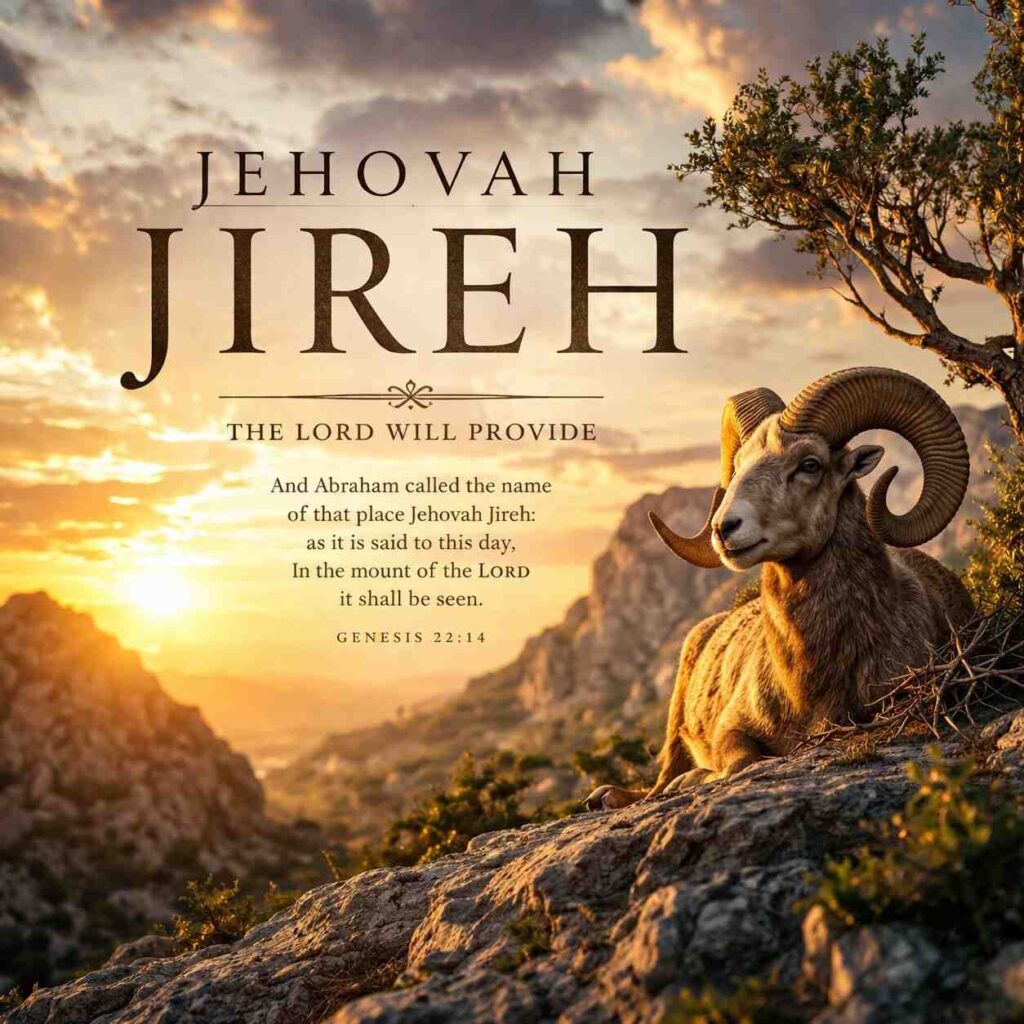
“So Abraham called that place The Lord Will Provide. And to this day it is said, ‘On the mountain of the Lord it will be provided.'” — Genesis 22:14 (NIV)
The Story Behind the Name: Abraham on Mount Moriah
To understand Jehovah Jireh, we must go back to one of the most gut-wrenching moments in all of Scripture. God asked Abraham to do the unthinkable — to offer his son Isaac, the child of promise, as a burnt offering on Mount Moriah.
Abraham obeyed in faith. With each step up that mountain, he chose trust over terror. He carried the wood, built the altar, and raised the knife. In that final, desperate moment—when obedience had cost him everything—God spoke.
“Abraham! Abraham! Do not lay a hand on the boy. Do not do anything to him. Now I know that you fear God, because you have not withheld from me your son, your only son.” (Genesis 22:11–12)
Caught in a thicket nearby was a ram—perfectly placed by God Himself. As a result, Isaac was spared, and the sacrifice was provided. Abraham named that mountain Jehovah Jireh because he understood something that would anchor his faith forever: God does not ask us to walk into impossible places without having already prepared our way through them.
The New Testament Fulfilment of This Promise: Jehovah Jireh.
The story of Abraham and Isaac on Mount Moriah was not merely a historical event — it was also a foreshadowing. Just as God provided a ram in the place of Isaac, He provided His own Son, Jesus Christ, in the place of all of us. Consequently, the ultimate expression of Jehovah Jireh is the cross itself.
“He who did not spare his own Son, but gave him up for us all — how will he not also, along with him, graciously give us all things?” — Romans 8:32 (NIV)
When you find yourself doubting whether God will provide for your financial need, your health crisis, your broken relationship, or your uncertain future — return to this verse. The God who gave His Son for you will not withhold what you truly need. Furthermore, Jehovah Jireh has already demonstrated the highest form of His provision at Calvary. Because of that, every lesser need is already covered by the same hands that held the cross.
5 Scriptures That Reveal God as Our Provider
1. Philippians 4:19
“And my God will meet all your needs according to the riches of his glory in Christ Jesus.”
Paul wrote these words from prison — a man with nothing by worldly standards, yet overflowing with certainty. Remarkably, God’s provision is not limited by our circumstances. Instead, it flows entirely from His inexhaustible glory.
2. Matthew 6:26
“Look at the birds of the air; they do not sow or reap or store away in barns, and yet your heavenly Father feeds them. Are you not much more valuable than they?”
Jesus invites us here to look at nature as a classroom for trust. If God sustains creation without being asked, then how much more intentional is His care for those made in His very image?
3. Psalm 34:10
“The young lions lack and suffer hunger; but those who seek the Lord lack no good thing.” (ESV)
Even the strongest creatures in the wild go hungry. However, the person who seeks Jehovah Jireh will never lack what is truly good for them. Notably, this verse reminds us that God’s provision is not just material — it is spiritual, emotional, and eternal.
4. 2 Corinthians 9:8
“And God is able to bless you abundantly, so that in all things at all times, having all that you need, you will abound in every good work.”
This verse captures the extraordinary generosity of God. His provision is not merely sufficient—it is abundant. Moreover, He provides so that we in turn can become a source of generosity to others.
5. Psalm 23:1
“The Lord is my shepherd; I shall not want.” (KJV)
Three words: I shall not want. David did not say, “I will eventually have enough.” Nor did he say, “I will struggle but survive.” He declared that want—total absence of unmet need—is simply not his story, because the Lord is his shepherd. When Jehovah Jireh leads your life, lack does not have the final word.
3 Prayers for Daily Provision and Trust
A Prayer When You Are in Financial Need
Heavenly Father, I come to You today with an open hand and a trusting heart. You are the God who sees my need before I even voice it. I confess that anxiety has tried to take hold of me, yet Your Word tells me that You will supply all my needs according to Your riches in glory. For this reason, I release my financial burdens to You right now. Provide for my family, Lord. Open doors that no man can shut, and send provision from places I cannot yet see. I trust not in my own ability, but in Your limitless power. In Jesus’ name, Amen.
A Prayer When You Feel Forgotten
Lord God, there are moments when I feel invisible — when my prayers seem to echo unanswered and my situation feels entirely unchanged. Nevertheless, in this moment I call on Your name, Jehovah Jireh. You see me. You saw Abraham on that mountain, and in the same way, you see me on mine. Remind my heart today that Your silence is not Your absence. Rather, you are working behind the scenes, already preparing my ram in the thicket. Strengthen my faith to keep climbing, even when I cannot see the summit. In Jesus’ name, Amen.
A Morning Prayer of Surrender
Good morning, Lord. Before this day begins, I lay every need, every worry, and every unknown at Your feet. You hold this day in Your hands, and You already know what I will face before I face it. Therefore, help me to walk in faith today — not by what I see, but by what I know of You. May I also be a channel of Your generosity to those around me, sharing the overflow of what You have so freely given. Thank You that I lack no good thing in You. In Jesus’ name, Amen.
Other Names of God That Reveal His Character
Understanding Jehovah Jireh becomes even richer when we place it alongside the other covenant names of God in Scripture. Each name, in fact, reveals a different facet of who He is and how He meets His people:
- Jehovah Jireh — The Lord Will Provide (Genesis 22:14)
- Jehovah Rapha — The Lord Who Heals (Exodus 15:26)
- Jehovah Shalom — The Lord Is Peace (Judges 6:24)
- Jehovah Nissi — The Lord Is My Banner (Exodus 17:15)
- Jehovah Roi — The Lord Is My Shepherd (Psalm 23:1)
- Jehovah Shammah — The Lord Is There (Ezekiel 48:35)
Together, these names paint a portrait of a God who is not distant or indifferent. On the contrary, He is intimately present in every dimension of our lives — providing, healing, bringing peace, and always near.
Three Practical Ways to Walk in Daily Faith
Trusting God as your provider is not a passive posture — it is an active, daily decision. Here are three practical ways to cultivate that trust:
1. Practice gratitude before provision arrives. Abraham worshipped on the way up the mountain, not after the ram appeared. Similarly, cultivating a heart of thanksgiving during a season of waiting positions you to recognize God’s hand when it finally moves.
2. Choose obedience even in the dark. Abraham’s faith was proven not in the easy moments but in the hardest moments of his entire life. In the same way, when God asks you to take a step you cannot fully see, remember that He goes ahead of you.
3. Keep a written record of God’s faithfulness. Write down the specific ways God has provided for you in the past. When new needs arise, that record becomes a personal testimony that strengthens your faith for the next mountain you face.
“Trust in the Lord with all your heart and lean not on your own understanding; in all your ways submit to him, and he will make your paths straight.” — Proverbs 3:5–6 (NIV)
Frequently Asked Questions
What does Jehovah Jireh mean in English?
Jehovah Jireh is a Hebrew name for God that translates to “The Lord Will Provide.” It first appears in Genesis 22:14, spoken by Abraham after God provided a ram as a substitute sacrifice for his son Isaac on Mount Moriah.
How do you pronounce Jehovah Jireh?
In Hebrew it is pronounced “yeh-HOH-vah yeer-EH.” In English, it is most commonly said as “jih-HOH-vah JEER-uh.” Both pronunciations are widely used in Christian worship and praise music around the world.
Is this name only about financial provision?
Not at all. While financial provision is one dimension of what this name reveals, it encompasses all forms of God’s care: spiritual strength, emotional peace, wisdom in decisions, physical healing, and ultimately salvation through Jesus Christ. The root word raah — to see — indicates that God perceives every kind of need and provides for each one accordingly.
What is the key Bible verse connected to this name?
The foundational verse is Genesis 22:14. For New Testament believers, however, Philippians 4:19 — “My God will supply all your needs according to his riches in glory in Christ Jesus” — is one of the most powerful expressions of this same truth for the Church age.
How can I pray using this name of God?
Simply speak to God by this name and acknowledge His nature as your Provider. Be specific about your need, express your trust in His faithfulness, and thank Him in advance for what He will do. The three prayers included above are a strong starting point.